
Reconstitute Peptides with BAC WaterStep-by-Step Visual Guide

| At a Glance | |
|---|---|
| What it is | Mixing lyophilized (freeze-dried) peptide with bacteriostatic water |
| Time required | 5–10 minutes |
| Key supplies | BAC water, peptide vial, syringe, alcohol swabs, gloves |
| Critical step | Use the calculator first to determine water volume |
| Storage after | Refrigerate at 36–46°F, use within 4–6 weeks |
Reconstitution is the process of mixing your lyophilized (freeze-dried) peptide powder with bacteriostatic water to create an injectable solution. This is a critical step that directly affects peptide stability and effectiveness—proper technique protects your investment and ensures consistent dosing. Take your time, work in a clean environment, and never rush this process.
Before you begin: Use our reconstitution calculator to determine exactly how much BAC water to add for your desired concentration. Having this number ready before you start prevents mistakes.
Step 1: Gather Your Supplies
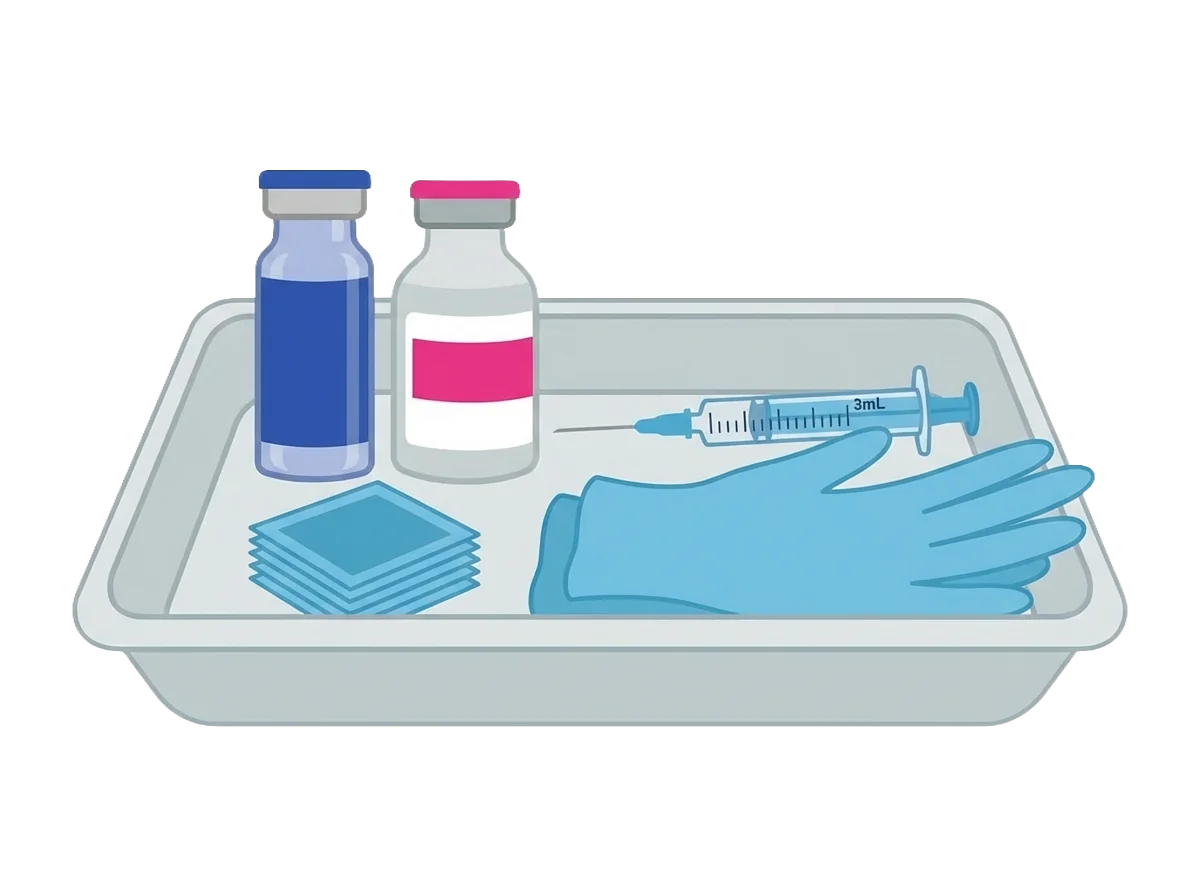
Before starting, ensure you have everything you need:
- Bacteriostatic (BAC) water — The standard reconstitution solvent containing 0.9% benzyl alcohol as a preservative
- Peptide vial — Your lyophilized peptide in its original sealed vial
- Syringe — A 3-5 mL syringe for drawing and transferring water (not your dosing syringe)
- Alcohol swabs — 70% isopropyl alcohol pads for sanitizing
- Disposable gloves — To maintain sterility and protect the peptide
Move to a clean work surface with good lighting.
Before starting, ensure you have everything you need:
- Bacteriostatic (BAC) water — The standard reconstitution solvent containing 0.9% benzyl alcohol as a preservative
- Peptide vial — Your lyophilized peptide in its original sealed vial
- Syringe — A 3-5 mL syringe for drawing and transferring water (not your dosing syringe)
- Alcohol swabs — 70% isopropyl alcohol pads for sanitizing
- Disposable gloves — To maintain sterility and protect the peptide
Move to a clean work surface with good lighting.
Step 2A: Prepare
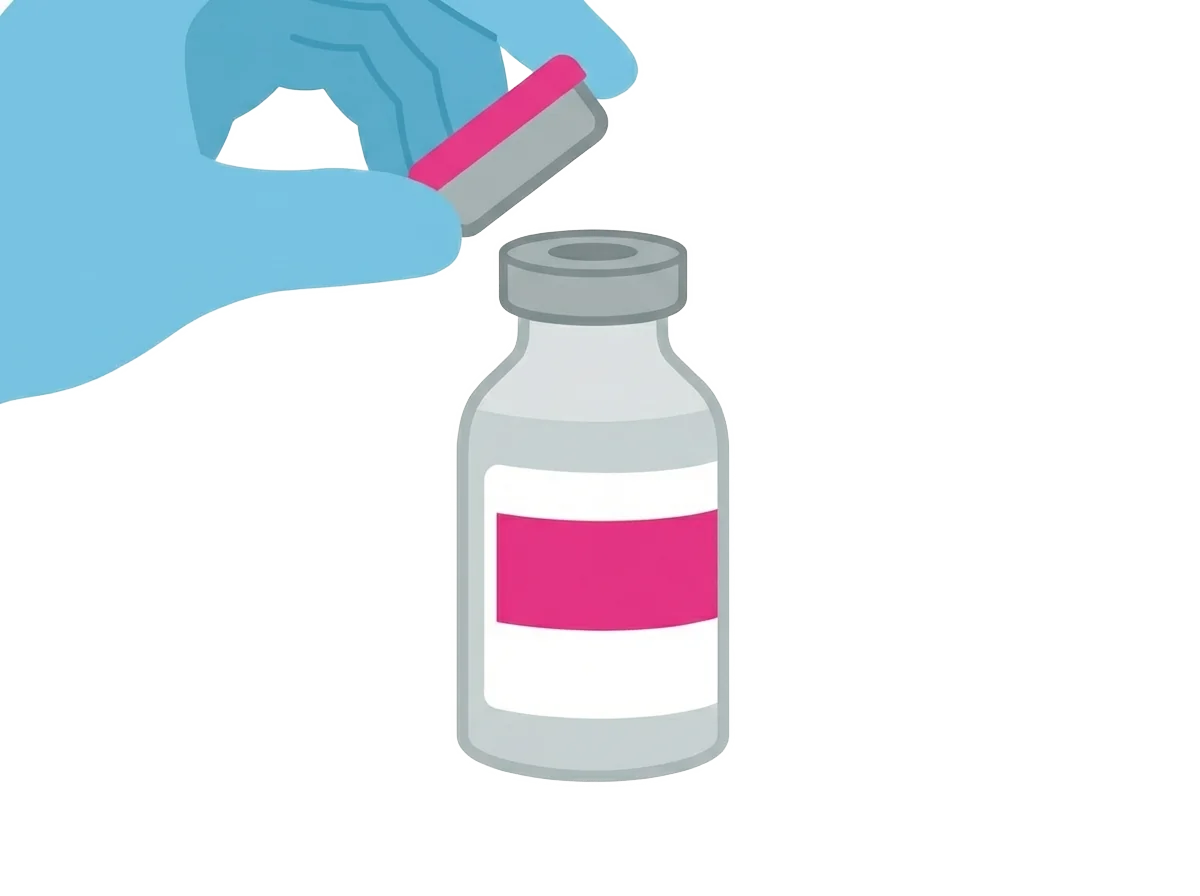
Preparation:
- Wash your hands thoroughly with soap and water
- Put on disposable gloves
- Remove the plastic caps from both the BAC water and peptide vials
Preparation:
- Wash your hands thoroughly with soap and water
- Put on disposable gloves
- Remove the plastic caps from both the BAC water and peptide vials
Step 2B: Sanitize
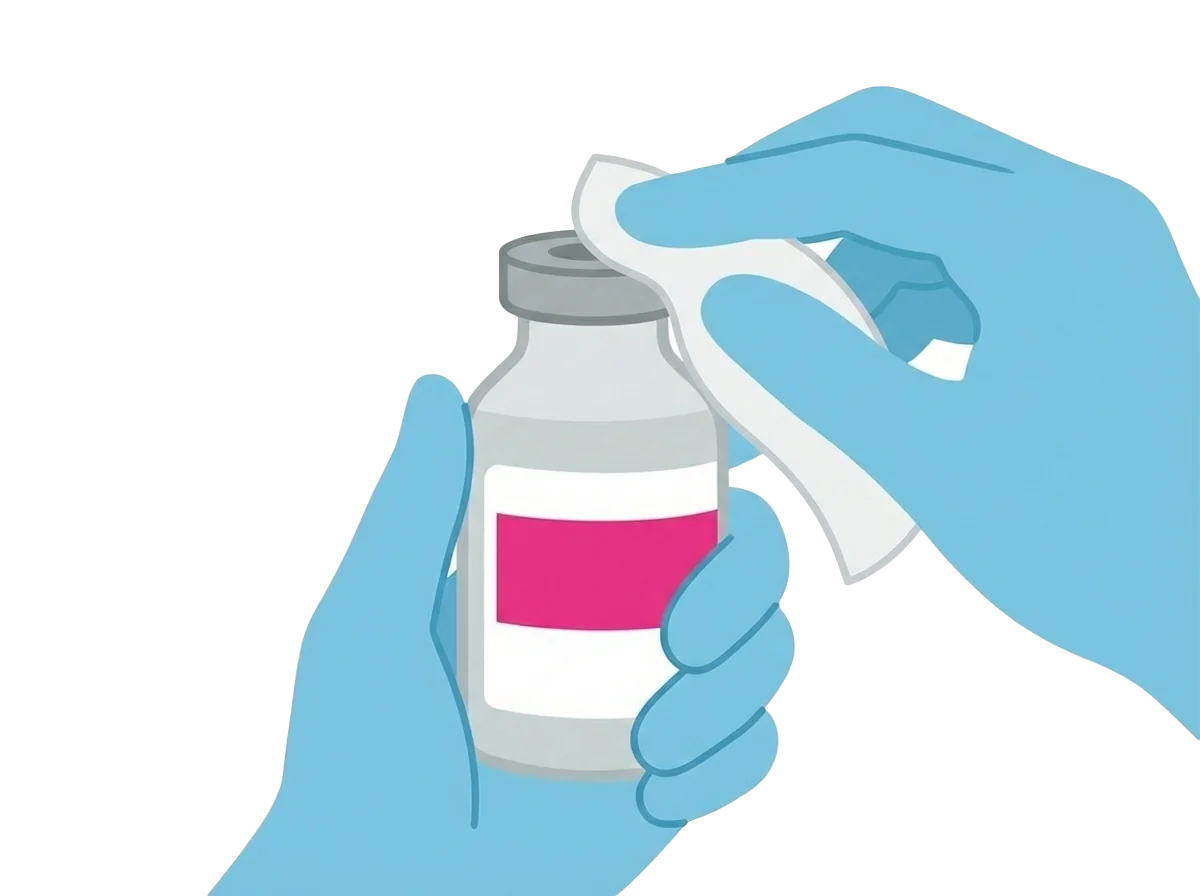
Sanitization:
- Use an alcohol swab to wipe the rubber stopper of the BAC water vial
- Use a fresh alcohol swab to wipe the rubber stopper of the peptide vial
- Do not touch the rubber stoppers after sanitizing
This step prevents contamination that could degrade your peptide or cause infection.
Sanitization:
- Use an alcohol swab to wipe the rubber stopper of the BAC water vial
- Use a fresh alcohol swab to wipe the rubber stopper of the peptide vial
- Do not touch the rubber stoppers after sanitizing
This step prevents contamination that could degrade your peptide or cause infection.
Step 3: Draw Bacteriostatic Water
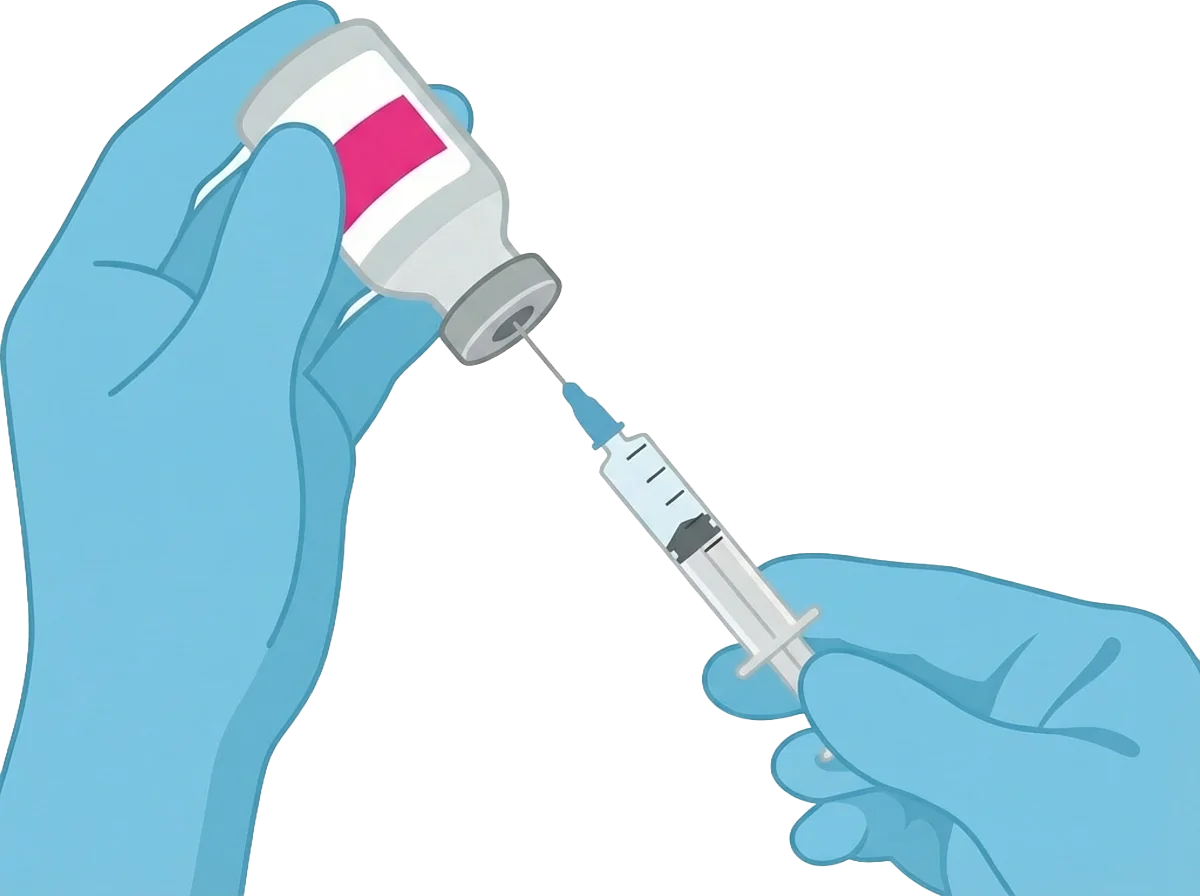
- Draw air into the syringe — Pull back the plunger to draw air equal to the amount of water you plan to extract (e.g., 2 mL of air for 2 mL of water)
- Carefully insert the needle through the center (precision matters) of the BAC water vial's rubber stopper
- Inject the air into the vial to displace the liquid
- Invert the vial so the rubber stopper faces down
- Draw your desired amount of water out slow by pulling back the plunger
- Check for air bubbles — Tap the syringe gently to move bubbles to the top, then push them back into the vial
How much water to add?
The amount depends on your desired concentration.
- Draw air into the syringe — Pull back the plunger to draw air equal to the amount of water you plan to extract (e.g., 2 mL of air for 2 mL of water)
- Carefully insert the needle through the center (precision matters) of the BAC water vial's rubber stopper
- Inject the air into the vial to displace the liquid
- Invert the vial so the rubber stopper faces down
- Draw your desired amount of water out slow by pulling back the plunger
- Check for air bubbles — Tap the syringe gently to move bubbles to the top, then push them back into the vial
How much water to add?
The amount depends on your desired concentration.
| Water Added | 5mg Peptide | 10mg Peptide |
|---|---|---|
| 1 mL | 5 mg/mL | 10 mg/mL |
| 2 mL | 2.5 mg/mL | 5 mg/mL |
| 2.5 mL | 2 mg/mL | 4 mg/mL |
Use our peptide dosing calculator to determine the optimal water volume for your specific peptide and dosing needs.
Step 4: Reconstitute the Peptide
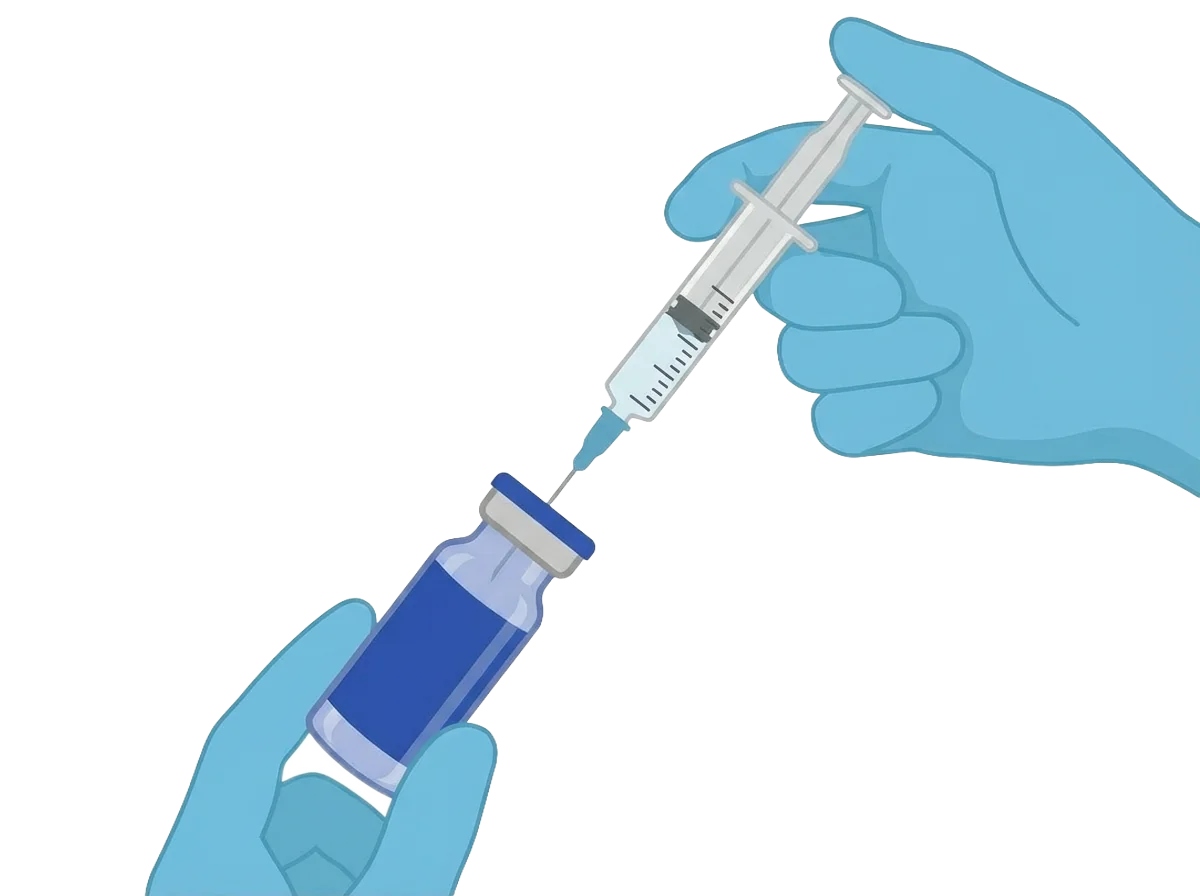
Critical technique:
- Carefully insert the needle through the center (precision matters) of the peptide vial's rubber stopper
- Angle toward the glass wall — Position the needle so it points at the inside wall of the vial, not directly at the powder
- Inject slowly — Let the water trickle down the side of the vial onto the powder
- Do not inject directly onto the powder — This can damage the peptide structure
- Do not use force — The water should flow gently; if there's resistance, reposition the needle
Why the side wall matters:
Peptides are fragile molecular chains. Forceful injection directly onto the powder can denature (unfold) the peptide, reducing its effectiveness. The gentle sidewall technique lets the powder absorb water gradually without mechanical stress.
Critical technique:
- Carefully insert the needle through the center (precision matters) of the peptide vial's rubber stopper
- Angle toward the glass wall — Position the needle so it points at the inside wall of the vial, not directly at the powder
- Inject slowly — Let the water trickle down the side of the vial onto the powder
- Do not inject directly onto the powder — This can damage the peptide structure
- Do not use force — The water should flow gently; if there's resistance, reposition the needle
Why the side wall matters:
Peptides are fragile molecular chains. Forceful injection directly onto the powder can denature (unfold) the peptide, reducing its effectiveness. The gentle sidewall technique lets the powder absorb water gradually without mechanical stress.
Step 5: Gently Swirl to Dissolve
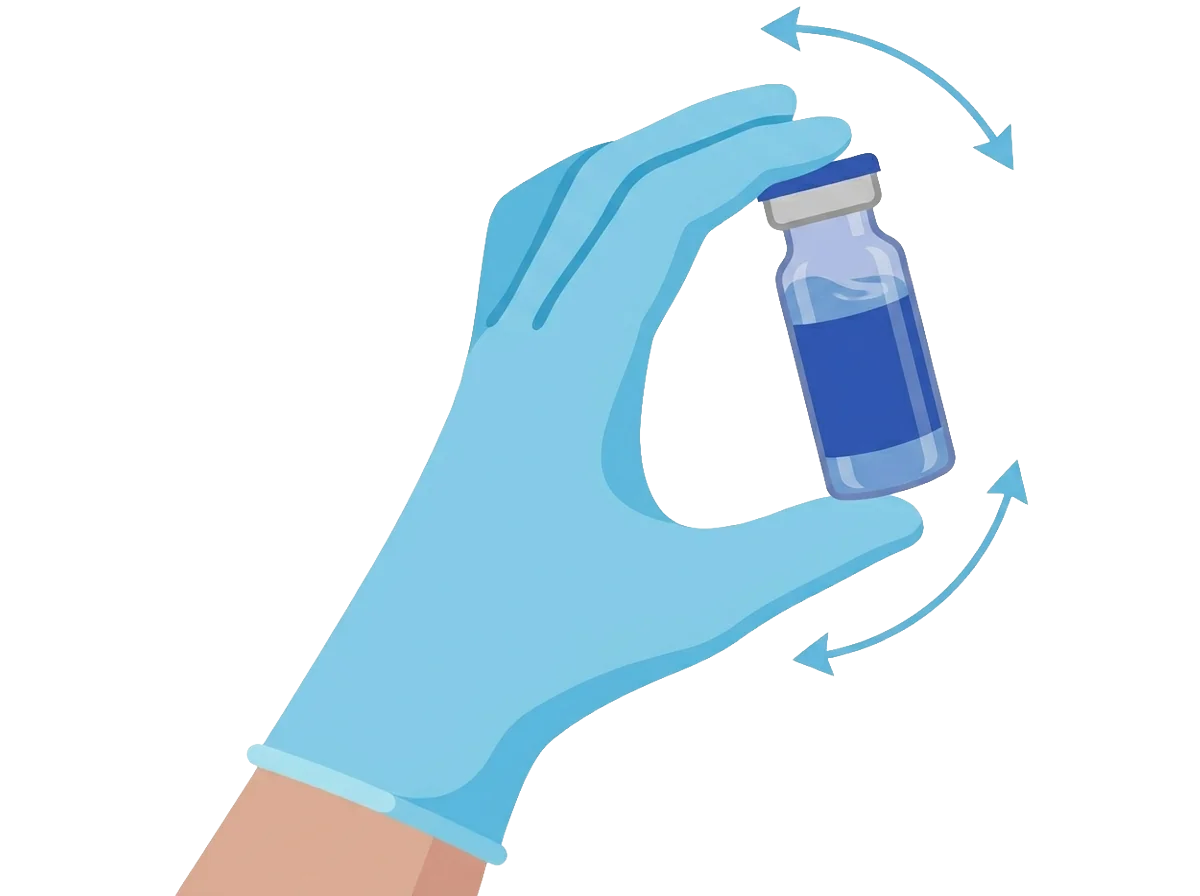
Dissolving technique:
- Remove the syringe from the vial after injecting all the water
- Hold the vial upright between your thumb and fingers
- Gently swirl or roll the vial in a slow, circular motion
- Continue until fully dissolved — The solution should be clear with no visible particles
- Be patient — Some peptides take 1-2 minutes to fully dissolve
Critical warning:
Do NOT shake the vial. Shaking creates air bubbles and mechanical forces that can damage the peptide's molecular structure. If you accidentally shake, let the vial sit undisturbed for several minutes before use.
What the solution should look like:
- Clear and colorless (exceptions: GLOW, KLOW, GHK-Cu will appear blue)
- No visible particles or cloudiness
- No foam or persistent bubbles
If the solution remains cloudy or has particles after several minutes of gentle swirling, do not use it — this may indicate degradation or contamination.
Dissolving technique:
- Remove the syringe from the vial after injecting all the water
- Hold the vial upright between your thumb and fingers
- Gently swirl or roll the vial in a slow, circular motion
- Continue until fully dissolved — The solution should be clear with no visible particles
- Be patient — Some peptides take 1-2 minutes to fully dissolve
Critical warning:
Do NOT shake the vial. Shaking creates air bubbles and mechanical forces that can damage the peptide's molecular structure. If you accidentally shake, let the vial sit undisturbed for several minutes before use.
What the solution should look like:
- Clear and colorless (exceptions: GLOW, KLOW, GHK-Cu will appear blue)
- No visible particles or cloudiness
- No foam or persistent bubbles
If the solution remains cloudy or has particles after several minutes of gentle swirling, do not use it — this may indicate degradation or contamination.
Step 6: Store Properly
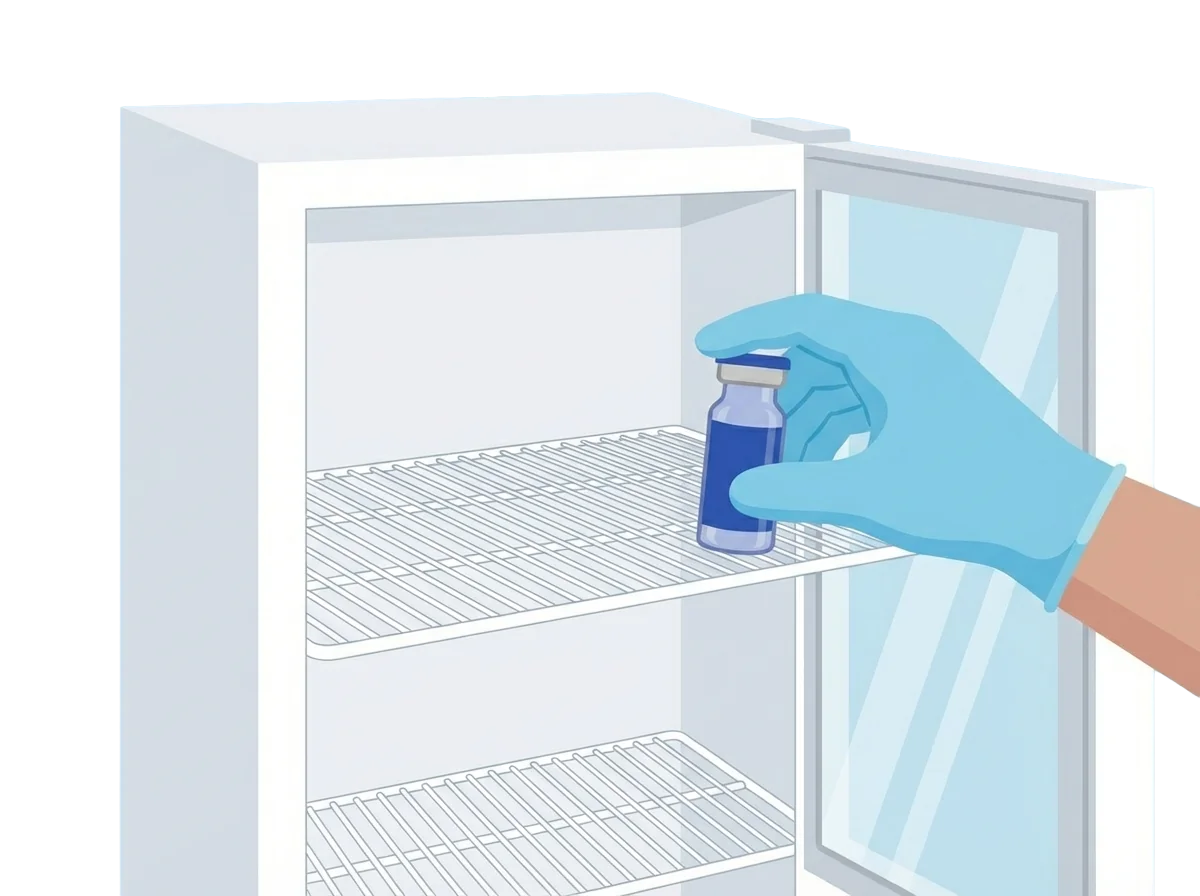
Storage tips:
- Return the vial to its original box or wrap in aluminum foil
- Store in the main refrigerator compartment (not the door — temperature fluctuates there)
- Label the vial with the reconstitution date and concentration
- Keep away from food to prevent accidental contamination
Storage tips:
- Return the vial to its original box or wrap in aluminum foil
- Store in the main refrigerator compartment (not the door — temperature fluctuates there)
- Label the vial with the reconstitution date and concentration
- Keep away from food to prevent accidental contamination
| Storage | Guideline |
|---|---|
| Temperature | Refrigerate at 36-46°F |
| Light exposure | Keep away from direct light |
| Duration | Use within 4-8 weeks (varies by peptide) |
| Freezing | Never freeze reconstituted peptides |
GLP-1 Peptides: Semaglutide, Tirzepatide & Retatrutide
GLP-1 peptides follow the same reconstitution process above. Here are compound-specific mixing ratios and unit calculations for common vial sizes.
How to Mix Semaglutide (Ozempic / Wegovy) | 5mg / 10mg / 20mg Vials
| Vial Size | BAC Water | Concentration | 0.25mg | 0.5mg | 1mg | 2.4mg |
|---|---|---|---|---|---|---|
| 5mg | 2 mL | 2.5 mg/mL | 10 units | 20 units | 40 units | 96 units |
| 10mg | 2 mL | 5 mg/mL | 5 units | 10 units | 20 units | 48 units |
| 10mg | 4 mL | 2.5 mg/mL | 10 units | 20 units | 40 units | 96 units |
| 20mg | 4 mL | 5 mg/mL | 5 units | 10 units | 20 units | 48 units |
| 20mg | 8 mL | 2.5 mg/mL | 10 units | 20 units | 40 units | 96 units |
Recommended: 2mL per 5mg creates a 2.5 mg/mL concentration — easy math for standard titration doses. At this concentration, 10 units = 0.25mg.
Dissolution note: Semaglutide may take 1-2 minutes of gentle swirling to fully dissolve. This is normal — do not shake.
For full dosing protocols, see our Semaglutide Guide.
How to Mix Tirzepatide (Mounjaro / Zepbound) | 10mg / 20mg / 30mg Vials
| Vial Size | BAC Water | Concentration | 2.5mg | 5mg | 7.5mg | 10mg | 15mg |
|---|---|---|---|---|---|---|---|
| 10mg | 2 mL | 5 mg/mL | 50 units | 100 units | — | — | — |
| 20mg | 2 mL | 10 mg/mL | 25 units | 50 units | 75 units | 100 units | — |
| 20mg | 4 mL | 5 mg/mL | 50 units | 100 units | — | — | — |
| 30mg | 3 mL | 10 mg/mL | 25 units | 50 units | 75 units | 100 units | — |
| 30mg | 6 mL | 5 mg/mL | 50 units | 100 units | — | — | — |
Recommended: For 10mg vials, use 2mL. For 20mg and 30mg vials, matching mL to half the mg (4mL for 20mg, 6mL for 30mg) creates a clean 5 mg/mL concentration.
For full dosing protocols, see our Tirzepatide Guide.
How to Reconstitute Retatrutide | 10mg / 12mg / 24mg Vials
| Vial Size | BAC Water | Concentration | 1mg | 2mg | 4mg | 8mg | 12mg |
|---|---|---|---|---|---|---|---|
| 10mg | 2 mL | 5 mg/mL | 20 units | 40 units | 80 units | — | — |
| 12mg | 2 mL | 6 mg/mL | ~17 units | ~33 units | ~67 units | — | — |
| 12mg | 2.4 mL | 5 mg/mL | 20 units | 40 units | 80 units | — | — |
| 24mg | 2.4 mL | 10 mg/mL | 10 units | 20 units | 40 units | 80 units | 120 units |
| 24mg | 4.8 mL | 5 mg/mL | 20 units | 40 units | 80 units | — | — |
Recommended: 2.4mL per 12mg creates a clean 5 mg/mL concentration. For 24mg vials, 4.8mL maintains the same concentration for consistent dosing across vial sizes.
For full dosing protocols, see our Retatrutide Guide.
Common Mistakes to Avoid
1. Shaking the Vial
The mistake: Shaking vigorously to speed up dissolution.
Why it's a problem: Shaking creates mechanical stress and air bubbles. The turbulence can unfold (denature) peptide chains, reducing potency. Foam indicates protein damage.
The fix: Gentle swirling only. Patience is essential.
2. Using the Wrong Water
The mistake: Using sterile water, distilled water, or saline instead of bacteriostatic water.
Why it's a problem: Only bacteriostatic water contains benzyl alcohol, which prevents bacterial growth over time. Sterile water is fine for single-use but will not preserve the peptide for weeks.
The fix: Always use bacteriostatic water for peptides you'll use over multiple doses.
3. Injecting Water Too Fast or Directly onto Powder
The mistake: Pushing the plunger quickly or aiming at the peptide cake.
Why it's a problem: Force can damage the peptide structure. Direct impact disrupts the molecular chains.
The fix: Inject slowly along the vial wall. Let water trickle down.
4. Temperature Shock
The mistake: Reconstituting a cold peptide immediately after removing from the freezer.
Why it's a problem: Rapid temperature changes can stress the peptide and affect stability.
The fix: Let frozen peptides warm to refrigerator temperature for 30 minutes before reconstitution. Let refrigerated peptides sit at room temperature for 5-10 minutes.
5. Contamination
The mistake: Touching rubber stoppers, reusing needles, or working in unclean conditions.
Why it's a problem: Bacteria introduced during reconstitution will multiply over days/weeks, degrading the peptide and creating infection risk.
The fix: Always sanitize, use fresh needles for each penetration, work in a clean space, wear gloves.
6. Improper Storage
The mistake: Leaving reconstituted peptides at room temperature or in bright light.
Why it's a problem: Heat and UV light accelerate degradation. Most peptides lose significant potency within days at room temperature.
The fix: Refrigerate immediately after reconstitution. Store in dark or opaque container.
Storage and Stability
| Before Reconstitution (Lyophilized Powder) | Expected Stability |
|---|---|
| Frozen (-20°F) | 12-24 months |
| Refrigerated (36-46°F) | 6-12 months |
| Room temperature | 1-3 months (avoid if possible) |
| After Reconstitution (Solution) | Expected Stability |
|---|---|
| Refrigerated (36-46°F) | 4-8 weeks (varies by peptide) |
| Room temperature | Days only — avoid |
| Frozen | Never freeze reconstituted peptides |
Signs of Peptide Degradation
Watch for these warning signs:
- Cloudiness — The solution should remain clear
- Particles or precipitate — Visible specks indicate protein aggregation
- Color change — Most peptides are colorless; yellowing suggests oxidation
- Unusual odor — Fresh peptide solutions are odorless
- Reduced efficacy — If effects diminish despite consistent dosing
If you notice any of these signs, discard the peptide and start fresh.
Calculate Your Dose
After reconstitution, you need to know how much solution equals your desired dose. This depends on:
- Peptide amount in the vial (e.g., 5mg, 10mg)
- Water volume you added
- Your target dose (e.g., 500mcg)
Example calculation:
- Peptide: 5mg (5000mcg)
- Water added: 2mL
- Concentration: 5000mcg ÷ 2mL = 2500mcg/mL
- Target dose: 500mcg
- Volume to inject: 500 ÷ 2500 = 0.2mL (20 units on an insulin syringe)
Skip the math — use our peptide dosing calculator for instant, accurate calculations.
Reading Your Syringe for Accurate Dosing
Most peptide users inject with U-100 insulin syringes. Here's how to read them:
| U-100 Syringe Units | mL Equivalent |
|---|---|
| 5 units | 0.05 mL |
| 10 units | 0.1 mL |
| 25 units | 0.25 mL |
| 50 units | 0.5 mL |
| 100 units | 1 mL |
Key conversion: On a U-100 syringe, 10 units = 0.1 mL.
Tip: For doses under 20 units, a 0.3mL or 0.5mL syringe with 1-unit markings provides better precision than a 1mL syringe with 2-unit markings.
FAQ
How much bacteriostatic water should I add to my peptide?
The amount depends on your desired concentration and dosing convenience. Common choices are 1–2.5 mL.
Adding more water creates a more dilute solution — easier to measure small doses precisely, but means larger injection volumes. Adding less creates a more concentrated solution — smaller injections, but requires more precise measurement.
Use the dosing calculator to find the optimal volume for your specific peptide and dose.
How do I calculate the concentration after reconstitution?
Divide the peptide amount by the water volume. Example: 5mg peptide in 2mL water = 5000mcg ÷ 2mL = 2500mcg/mL. Then divide your target dose by this concentration to get injection volume. For 500mcg: 500 ÷ 2500 = 0.2mL (20 units on a 100-unit insulin syringe). The calculator does this automatically.
What size syringe should I use for reconstitution?
Use a 3–5 mL syringe with a 21–25 gauge needle for reconstitution (drawing water and injecting into the peptide vial). For dosing, use insulin syringes (28–31 gauge, 0.5–1 mL), which are finer and more comfortable for subcutaneous injection. Never reuse syringes.
Why can't I shake the vial to dissolve the peptide faster?
Peptides are long chains of amino acids folded into specific 3D structures. Shaking creates mechanical stress that can unfold (denature) these structures, destroying the peptide's activity. The foam you see after shaking indicates protein damage. Always use gentle swirling or rolling.
Can I use sterile water instead of bacteriostatic water?
Only if you're using the entire vial in a single dose. Sterile water has no preservative, so bacteria can multiply once the vial is penetrated. For any multi-dose use (the vast majority of protocols), bacteriostatic water is essential.
| Feature | Bacteriostatic Water | Sterile Water |
|---|---|---|
| Preservative | 0.9% benzyl alcohol | None |
| Multi-use safe | Yes | No — contaminated after first use |
| Best for | Peptides used over days/weeks | Single-use injections |
What happens if I add too much water?
Nothing harmful — you've just created a more dilute solution, which means larger injection volumes for the same dose. Update the water volume in the calculator and it will recalculate automatically. The peptide is unaffected.
How do I avoid contaminating my peptide?
- Sanitize rubber stoppers with alcohol and let dry before each penetration
- Use a fresh needle each time you pierce a vial
- Wear disposable gloves
- Work on a clean surface
- Use bacteriostatic water (the benzyl alcohol preservative inhibits bacterial growth)
Contamination is the leading cause of peptide degradation in home use.
Should I let the peptide warm up before reconstituting?
Yes. If stored frozen, let the vial reach refrigerator temperature (30–60 minutes) before reconstituting. If refrigerated, let it sit at room temperature for 5–10 minutes. Never reconstitute a still-frozen peptide.
Storage
How long does a reconstituted peptide last?
Most reconstituted peptides remain stable for 4–6 weeks when refrigerated at 36–46°F and protected from light.
| Peptide | Typical Stability |
|---|---|
| BPC-157 | 4–6 weeks refrigerated |
| TB-500 | 4–6 weeks refrigerated |
| Semaglutide | 4–6 weeks refrigerated |
| Tirzepatide | 4–6 weeks refrigerated |
| GHK-Cu | 2–4 weeks refrigerated |
| MOTS-c | 2–4 weeks refrigerated |
| NAD+ | 2–4 weeks refrigerated |
When in doubt, prepare smaller volumes more frequently rather than large batches that sit for weeks.
Do I need to refrigerate reconstituted peptides?
Yes, always. Reconstituted peptides degrade rapidly at room temperature. Refrigerate immediately after reconstitution at 36–46°F. Store in the main compartment (not the door, where temperatures fluctuate) and protect from light.
Can I freeze reconstituted peptides?
No. Lyophilized (powder) peptides can be frozen for long-term storage, but reconstituted solutions should never be frozen. Ice crystal formation physically damages peptide structures, reducing potency and causing precipitation when thawed.
How do I know if my peptide has gone bad?
- Cloudiness (should be clear)
- Visible particles or precipitate
- Color change (most are colorless; GHK-Cu solution appears blue — that is normal)
- Foam that doesn't dissipate
- Diminishing results despite consistent dosing
When in doubt, discard and reconstitute fresh.
Peptide-Specific Reconstitution
How much bacteriostatic water do I add to a 5mg vial?
For a 5mg vial — common for semaglutide, BPC-157, TB-500, and many other peptides — add 2mL. This creates a 2.5mg/mL (2500mcg/mL) concentration:
- Semaglutide: 10 units = 0.25mg
- BPC-157: 20 units = 500mcg
- TB-500: 20 units = 500mcg
Use 1mL for a more concentrated solution or 2.5mL for easier measurement of small doses.
What is the standard mixing ratio for semaglutide (Ozempic/Wegovy)?
The most common ratio is 2mL to a 5mg vial, giving 2.5mg/mL. At this concentration:
- 10 units = 0.25mg (starting dose)
- 20 units = 0.5mg
- 40 units = 1mg
- 96 units = 2.4mg (maintenance dose)
For larger vials (10mg, 20mg), double or quadruple the water to maintain the same concentration.
How do I mix NAD+?
NAD+ requires extra attention:
Use saline BAC water. NAD+ is naturally acidic and causes significant injection site irritation. Bacteriostatic water with sodium chloride (saline BAC water) buffers the pH and substantially reduces burning. Standard benzyl-alcohol-only BAC water will work but is noticeably more uncomfortable.
Mixing technique: Add BAC water slowly along the vial wall. NAD+ may take 2–3 minutes of gentle swirling to fully dissolve. The solution should be clear and colorless when ready.
Reconstituted stability: 2–4 weeks refrigerated. Prepare smaller batches if your protocol allows — some users report reduced efficacy after 2 weeks.
What is the standard mixing ratio for tirzepatide (Mounjaro/Zepbound)?
A 5mg/mL concentration works well for most titration schedules. For a 10mg vial, add 2mL:
- 50 units = 2.5mg (starting dose)
- 100 units = 5mg
For 20mg and 30mg vials, use 4mL and 6mL respectively. Some users prefer 10mg/mL (half the water) for smaller injection volumes at higher doses.
How do I reconstitute BPC-157 and TB-500?
Add 2mL to a 10mg vial for a 5mg/mL concentration — this gives the cleanest unit math for both peptides.
For BPC-157 (dosed in micrograms): 5mg/mL = 5,000mcg/mL. A 250mcg dose = 5 units; 500mcg = 10 units.
For TB-500 (dosed in milligrams): 2.5mg = 50 units; 5mg = 100 units.
For a 5mg vial, add 1mL for the same 5mg/mL concentration. If using both in the Wolverine stack, reconstituting each at the same concentration makes drawing straightforward.
How do I reconstitute GLOW or KLOW?
Add 3mL of bacteriostatic water to a standard GLOW vial (75mg total, giving ~25mg/mL) or KLOW vial (85mg total, giving ~28mg/mL). The standard dose is 0.15mL (15 units), giving roughly 20 doses per vial.
Note: GHK-Cu solution appears blue after reconstitution — this is normal. Swirl gently; do not shake.
For full dosing protocol, see the GLOW & KLOW protocol guide.
How do I reconstitute Semax or Selank?
Both can be administered intranasally or subcutaneously — and the reconstitution approach differs by route.
Nasal spray: Use bacteriostatic saline (0.9% NaCl with preservative), not standard BAC water — benzyl alcohol alone can irritate nasal mucosa. A standard working concentration is 1mg/mL (0.1%): add 10mL to a 10mg vial. A typical nasal pump delivers ~100mcg per spray, so a 300mcg dose = 3 sprays.
Subcutaneous injection: Standard BAC water works fine for SubQ. Add 2mL to a 10mg vial for 5mg/mL (5,000mcg/mL): 250mcg = 5 units, 500mcg = 10 units.
N-Acetyl Amidated versions (NA-Semax Amidate, NA-Selank Amidate) have protective modifications at both ends of the peptide chain that increase stability and bioavailability. The same reconstitution approach applies for either route, but the effective dose is higher per microgram — typically 100–200mcg achieves what 250–500mcg of the unmodified form would.
Reconstituted stability: 4–6 weeks refrigerated for both routes. Store away from light.
Related Topics
- Peptide Dosing Calculator — Calculate exact injection volumes
- BPC-157 Protocol Guide — Dosing and applications
- Semaglutide Guide — GLP-1 peptide protocol
- Tirzepatide Guide — Dual GLP-1/GIP protocol
- Retatrutide Guide — Triple-agonist protocol
- NAD+ Guide — NAD+ peptide protocol
- TB-500 for Injury Recovery — BPC-157 + TB-500 stack
- TB-500 Guide — Dosing and storage for Thymosin Beta-4
- GHK-Cu Guide — Note: GHK-Cu solution appears blue — normal
- GLOW & KLOW Protocol — Multi-peptide protocol requiring careful reconstitution
- MOTS-c Guide — Short refrigerated stability window — plan doses accordingly
References
- Wang W. Instability, stabilization, and formulation of liquid protein pharmaceuticals. Int J Pharm 1999. PubMed study (PMID: 10482990)
- Manning MC et al. Stability of protein pharmaceuticals: an update. Pharm Res 2010. DOI: 10.1007/s11095-009-0045-6
- USP General Chapter <797> Pharmaceutical Compounding — Sterile Preparations
Educational content only. Work with a qualified healthcare provider for any peptide protocol.
Medical Disclaimer
The content in this protocol guide is for informational purposes only and does not constitute medical advice. Always consult with a qualified healthcare provider before beginning any new protocol, supplement, or medication.